Vapour degreasing solvents are the backbone of precision cleaning lines in electronics, aerospace, medical-device and optical manufacturing across Australia and New Zealand. The right vapour degreasing solvent strips ionic, particulate and bonded contamination in seconds with no residue, no rinsing and no post-clean drying. The wrong one burns through your operating budget, fails compliance audits or damages substrates. This guide breaks down the 7 best vapour degreasing solvents on the market in 2026 and gives you a clear framework for picking the right one.
| Solvent family | Best for | Boiling point | Environmental profile |
|---|---|---|---|
| HFE (hydrofluoroethers) | Precision electronics, medical implants | 34–76 °C | Low GWP, zero ODP, AICIS-listed |
| HFO blends | Aerospace, optics, photonics | 19–43 °C | Very low GWP, replacing legacy HFCs |
| Modified alcohols | Stainless, precision optics, polymers | 72–82 °C | Non-halogenated, no ODP, low GWP |
| n-Propyl bromide (nPB) | Heavy oils, defluxing, automotive | 71 °C | High GWP and reproductive-toxin flags, phase-down advised |
| Trans-DCE blends | Soldering flux, light oils | 40–55 °C | Lower GWP than nPB, faster drying |
| Hydrocarbon solvents | Heavy degreasing, parts cleaning | 80–200 °C | VOC-regulated, flammable, requires sealed systems |
| Trichloroethylene (TCE) | Heavy industrial, legacy lines | 87 °C | SVHC/REACH restricted, replace where possible |
A vapour degreaser holds the chosen solvent at its boiling point in a sealed sump. Vapour rises and condenses on the cooler parts being cleaned, dissolving contamination and carrying it back into the sump. Once the part reaches vapour temperature, condensation stops and the part leaves the system dry, with no rinsing required. The cycle is fast, repeatable, and the solvent is recovered and reused, typically for thousands of cycles before refresh.
What separates vapour degreasing solvents from aqueous chemistries is the combination of speed (often under 60 seconds), residue-free finish, and ability to clean intricate geometries, blind holes, micro-channels, and stacked assemblies that water-based cleaners cannot reach without manual intervention.
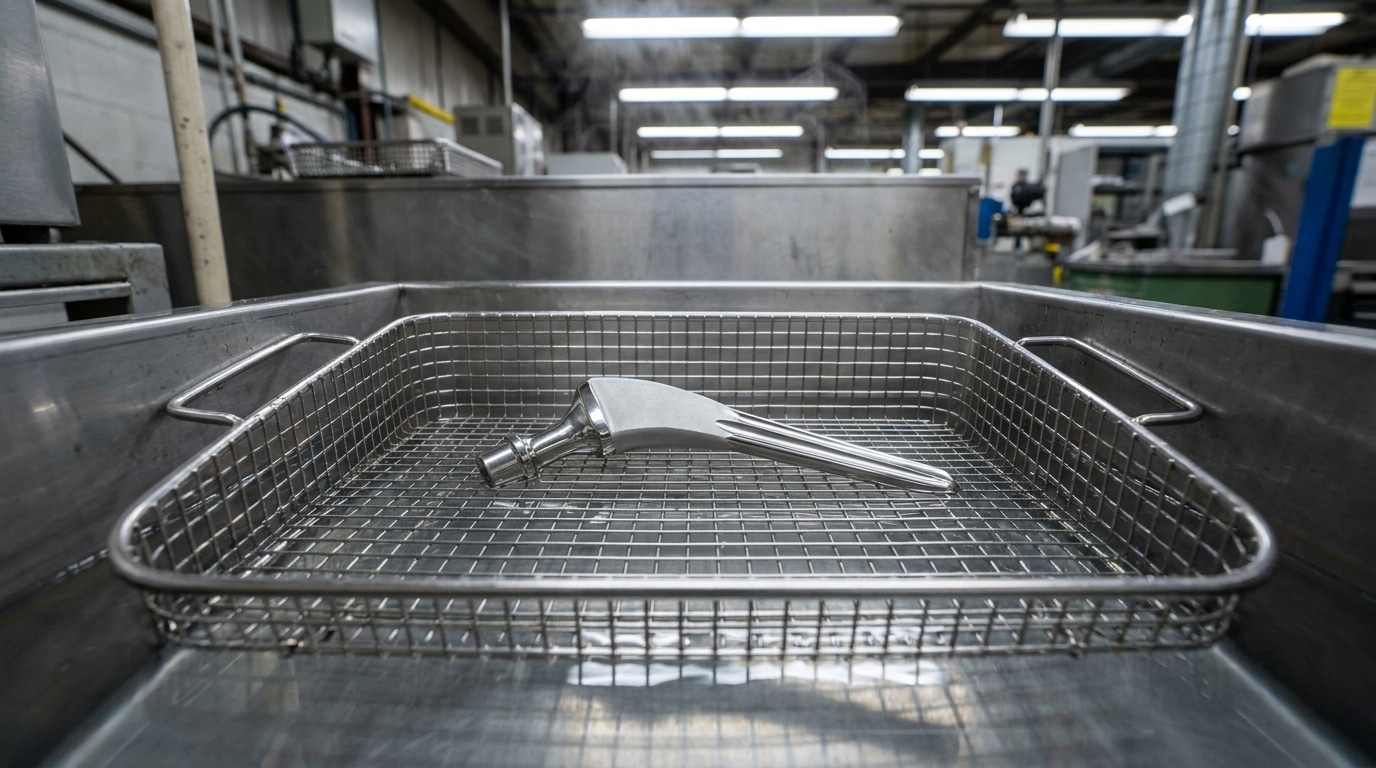
HFE-based vapour degreasing solvents (e.g. Techspray Precision-V) dominate modern electronics and medical-implant cleaning. They offer zero ozone-depletion potential, low global warming potential and excellent material compatibility. Boiling points span 34–76 °C, letting you tune drying speed to your substrate.
Hydrofluoroolefins are the newest generation. Ultra-low GWP, fast evaporation and good with sensitive polymers. Adoption is accelerating in aerospace and photonics where regulatory tailwinds matter.
Non-halogenated, non-flammable in vapour-phase systems and effective on light oils and ionic residue. Higher boiling points (around 80 °C) mean slightly slower throughput.
Aggressive solvent power for heavy oils and stubborn flux. Still in use but flagged by AICIS and equivalent bodies as a reproductive toxin and high-GWP compound. Active phase-out programs run in most OEM supply chains.
Common nPB replacement with lower toxicity profile. Often blended with HFEs for fine-tuned solvency.
For heavy industrial degreasing where electronics-grade purity is not required. Cheaper but flammable and VOC-regulated, sealed degreasers and nitrogen blanketing are typical.
Historically the workhorse for heavy industrial vapour degreasing. Now restricted under REACH and listed as a substance of very high concern. New installations almost universally choose HFEs or HFOs instead.
Match the vapour degreasing solvent to your job using four practical filters:
Three trends shape vapour degreasing solvent selection in 2026:
The market has consolidated decisively around HFE, HFO and modified-alcohol vapour degreasing solvents for new installations. Legacy nPB, TCE and high-GWP HFCs are being designed out of supply chains driven by both regulation and customer mandate. The best vapour degreasing solvent for your line is whichever chemistry matches your contamination type, substrate sensitivity and 5-year regulatory horizon, at a total cost of ownership your finance team can defend.
Browse ProfTek’s vapour degreasing solvent range, including Techspray Precision-V and complementary thermal-transfer fluids. Or review the wider industrial materials catalogue for related precision-cleaning chemistries.
Not sure which vapour degreasing solvent fits your line? Our engineering team will walk through your contamination profile, substrate mix and compliance requirements before recommending a chemistry. Cross-reference our ultrasonic and megasonic cleaner range if your process benefits from a hybrid mechanical-and-solvent approach.