Protective clothing must address the complete workplace risk. A mining or mineral processing task may combine electrostatic discharge, corrosive chemicals, vehicle movement, weather, heat, flame and gas monitoring requirements. A garment selected for one hazard may not provide suitable protection against the others.
The correct approach is to assess the task and select a certified clothing system for the combined hazards. This is particularly important where workers may encounter sulphuric acid or another corrosive chemical. Fibre composition matters, but it is not a chemical protection rating.
Personal protective equipment should not be the first or only control used for hazardous chemicals. Safe Work Australia places PPE near the bottom of the hierarchy of controls because it does not remove the hazard.
Elimination, substitution, isolation and engineering controls should be considered first. PPE is then used with those controls to manage the remaining exposure risk.
Before selecting antistatic chemical protective clothing, review:
The SDS should identify suitable skin, eye and respiratory protection for the particular chemical and task. Safe Work Australia provides further guidance on using safety data sheets for hazardous chemicals.
Sulphuric acid is a corrosive hazardous chemical, but the chemical name alone is not enough to select PPE. A small splash from a diluted solution is not the same exposure as concentrated acid, a pressurised leak, hot process liquid or prolonged contact.
Chemical concentration, temperature, pressure, contact time and the area of the body at risk can all change the required level of protection.
A garment described as providing limited chemical splash protection should never automatically be described as sulphuric acid proof. For larger volume splashes, liquid jets, saturation or emergency response, a higher level of chemical protective clothing may be required.
The garment manufacturer’s penetration, repellency or permeation data must be checked against the site’s actual chemical concentration and exposure scenario. The current SDS and site risk assessment remain the starting point.
Ordinary cotton workwear should not be treated as chemical protective clothing merely because it is natural, heavy or comfortable. That does not mean cotton and other organic fibres can never be used.
Polyester is not automatically resistant to acid either. Corrosive chemicals can reduce the effectiveness of some synthetic materials. Protection depends on the complete garment: its fabric system, seams, closures, construction, certification, wearing instructions and specific chemical test results.
Different mine site tasks call for different combinations of protection. Depending on the risk assessment, available garment configurations may include:
The appropriate combination depends on the task, the chemical and the complete site risk assessment. This information does not replace a site specific risk assessment or specific chemical test evidence.
EN 1149-5 covers protective clothing designed to dissipate electrostatic charge as part of a properly earthed system. It does not protect against mains electricity.
Performance also depends on garment condition, correct fastening, suitable footwear, grounding and site conditions. Wear, contamination and incorrect laundering may affect antistatic performance.
EN 13034 Type 6 covers limited whole body protection against light liquid chemical spray or splashes when the garments are worn as the certified ensemble. PB[6] applies limited protection to parts of the body.
This is the lowest liquid chemical protection classification in the chemical protective clothing types. It should not be confused with protection against liquid jets, saturation, immersion or prolonged contact. The tested chemicals, concentrations and penetration or repellency results remain essential.
Mining workers may require additional protection around vehicles, hot work, combustible atmospheres or electrical equipment. A clothing specification for multiple hazards may therefore need standards addressing high visibility, heat and flame, welding, arc flash, electrostatic dissipation and limited chemical splash.
Each certification addresses a particular hazard. One certification should never be assumed to cover another, and overseas high visibility certification does not automatically prove compliance with every Australian mine or site requirement.
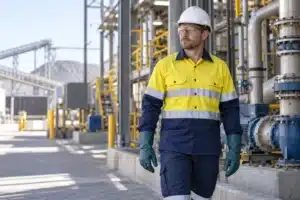
Mining workwear often has to do more than one job. A worker may need to remain visible around mobile equipment, control electrostatic charge, work outdoors, carry communication or gas monitoring equipment and have documented protection against a defined level of chemical splash.
ProfTek can review available SIR Safety clothing configurations against the complete application instead of treating one material or one certification as the answer. This may involve selecting a lightweight antistatic garment for one work area, a weather resistant jacket with limited splash performance for another, or a matched ensemble for multiple hazards where several risks overlap.
Start with the current SDS, task details and site requirements. ProfTek can then narrow the options and confirm the relevant garment documentation before arranging samples, trials or supply.
It is protective clothing designed to address electrostatic charge hazards and a defined level of chemical exposure. The antistatic and chemical performance are separate properties and must each be supported by the relevant garment certification.
No. Type 6 is limited protection against light liquid spray or small volume splashes. Suitability still depends on the tested chemical, concentration, temperature, exposure method and complete ensemble.
No. Polyester content does not establish chemical resistance. Check the complete garment certification and specific chemical penetration, repellency or permeation data.
Not categorically. Ordinary cotton workwear is not chemical PPE, but some certified garments designed for multiple hazards contain cotton or other cellulose based fibres. The complete garment’s documented performance determines its suitability.
Type 6 applies limited splash protection to a complete body protection ensemble. PB[6] applies limited protection to part of the body, such as a jacket. Neither classification should be described as protection against every acid or every exposure.
A dedicated loop can provide a consistent attachment point that keeps a portable detector accessible. The detector must still be positioned, maintained, bump tested and calibrated according to its instructions and the site’s procedure.
Rather than selecting protective clothing from a product table alone, send ProfTek the current SDS, chemical concentration, task description, likely exposure method and the other mine site hazards that must be addressed.
ProfTek can help identify relevant clothing configurations, confirm which standards apply, request supporting test evidence and consider the complete system alongside chemical protective gloves, safety boots and gas detection requirements.
Explore ProfTek’s antistatic workwear range or contact our team for help matching garment features to the task and workplace risk.
Explore ProfTek’s industrial consumables and PPE range, or send an enquiry to discuss an antistatic chemical protective clothing requirement.
This article provides general information only. PPE must be selected through a site specific risk assessment and verified against current manufacturer documentation, chemical test data and applicable workplace requirements.