EN 388 is the European mechanical-risk standard that governs almost every industrial glove sold in Australia. Since the 2016 revision, the cut-resistance test moved from the old “Coup test” (rotating circular blade) to the more reliable ISO 13997 TDM (Tomodynamometer) test, which produces a single letter from A (lowest) to F (highest).
This guide explains what each cut level actually means, the test method behind it, and how to match the right level to your fabrication, metalwork, or food-processing hazard profile.
| EN 388 Level | Force to Cut (Newtons) | Typical Application |
|---|---|---|
| A | ≥ 2 N | Light assembly, packaging, light edges |
| B | ≥ 5 N | General mechanical assembly, light fabrication |
| C | ≥ 10 N | Automotive trim, light glass handling |
| D | ≥ 15 N | Sheet metal fabrication, HVAC ducting, glass packaging |
| E | ≥ 22 N | Recycling, primary metal handling |
| F | ≥ 30 N | Stamping, abattoir-grade butchery, high-edge fabrication |
“Force to cut” is the load applied perpendicular to a moving blade before the blade cuts through the glove material. Higher levels mean more force is required, which translates directly to better protection from sharp edges.
The old EN 388:2003 Coup test rated cut resistance from 1 to 5. The problem: the test blade dulled rapidly when cutting modern high-performance materials like HPPE (high-modulus polyethylene). A glove could test at “Level 5” on a freshly-sharpened blade and fail on the second test.
The 2016 ISO 13997 TDM test uses a single-use blade for every test and measures force directly. The result is repeatable and represents real-world cut performance. Any Sir Safety glove manufactured after 2017 carries the A–F letter rating.
Some manufacturers still show both ratings (legacy 1-5 number plus A-F letter) for transitional reasons. The letter is the authoritative one, ignore any reference to the legacy number if both are present.
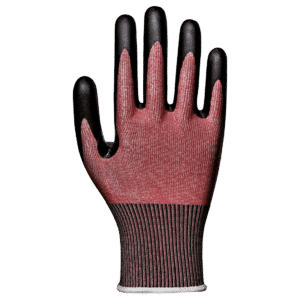
Suitable for assembly lines handling smooth components, packaging, light construction trim. A or B-rated gloves are typically the most dexterous, with thin polyurethane or foam-nitrile coatings on an 18-gauge liner. Workers can pick up small fasteners and operate touch-screen interfaces.
Most automotive fabrication, sheet metal work, HVAC installation, and glass packaging operations fall here. Level D is generally the default specification for any task involving cut metal edges or glass, it’s where most safety officers land after a hazard assessment.
The Sir Safety cut resistant range has multiple Level C and D options across nitrile, foam-nitrile, and PU coatings, so you can match the grip needed to your handling surface (dry, oily, or sharp-edged).
Level E is reserved for primary metal recycling, stamping operations, and any process where cut hazards are continuous rather than intermittent. Level F (introduced in the 2016 revision) is the highest non-armoured rating, used in abattoirs, the highest-hazard sheet-metal cutting, and structural steel work.
Above Level F, you move into chainmail constructions (stainless-steel mesh gloves), used in butchery, fish processing, and high-precision blade work. The Sir Safety butchers range (CM-8, CM-15, CM-20) covers these specialist applications.
EN 388 actually rates four mechanical properties, written as a four-character code:
So a glove rated “4544F” reads as: max abrasion (4), max tear (5 isn’t shown, re-check), max puncture (4), Level F cut. Most product datasheets show the four characters together.
1. Over-specifying. A Level F glove on a light assembly line reduces dexterity and worker compliance. Workers will remove gloves when they can’t grip small components, leaving them unprotected against actual hazards. Match the level to the hazard.
2. Under-specifying. The opposite error: choosing Level B for sheet-metal fabrication because “Level F gloves are expensive”. The cost of a single hand laceration (lost time + medical + workers’ comp) dwarfs the per-pair cost difference.
3. Ignoring the coating. An HPPE liner with the right cut rating but the wrong coating (smooth nitrile on oily steel) loses grip. The glove slips, the worker compensates by gripping harder, fatigue increases, and cut risk goes up. Always pair cut rating with the right coating for your surface.
4. Single-spec for multi-task crews. A fabricator may handle smooth assembly in the morning and sharp-edge sheet metal in the afternoon. A single glove specification rarely fits both. Issue two pairs and train workers to switch.
Cut-resistant gloves typically last 1-3 shifts before degradation requires replacement, sooner if the glove takes any visible damage. For sites with steady consumption, a standing order with monthly delivery cycles removes the procurement overhead. ProfTek can supply Sir Safety cut-resistant gloves across all six levels in any pack size for Australian and New Zealand industrial buyers.
Need help matching the right level to your application? Send us your hazard register or task description and we’ll spec the right Sir Safety SKU with bulk pricing.