Picking the wrong respirator class is one of the most common and most expensive workplace safety mistakes on Australian industrial sites. Under-specify FFP2 where FFP3 is required, and you have a non-compliant control with measurable health risk. Over-specify FFP3 where FFP2 is sufficient, and you triple per-unit cost on a high-velocity consumable that workers go through daily.
This guide explains the practical difference between FFP2 and FFP3 disposable respirators, how the European EN 149 standard maps to the Australian AS/NZS 1716, and exactly when each class is the right call.
FFP2 filters at least 94% of airborne particulates. Use for general dust, manufacturing fumes, pollen, and most construction sites where exposure is moderate. Roughly equivalent to AS/NZS 1716 P2.
FFP3 filters at least 99% of particulates and is required for asbestos, silica (concrete cutting, stonemasonry), pharmaceutical actives, and biohazards. Roughly equivalent to AS/NZS 1716 P3.
If you’re handling anything on the National Occupational Exposure Limits “carcinogen” or “potent respiratory sensitiser” list, the answer is FFP3, period.
EN 149:2001+A1:2009 is the European standard that governs disposable filtering half-mask respirators. It defines three classes:
Every Sir Safety respirator carries the EN 149 marking plus optional codes: NR = non-reusable (single shift), R = reusable, D = passes the dolomite clogging test (longer service life in dusty environments), and V = has an exhalation valve.
Australia’s AS/NZS 1716:2012 uses a P-class system rather than FFP-class. The practical equivalence:
| EN 149 (Europe) | AS/NZS 1716 (Australia) | Min. Filtration | Max. Exposure |
|---|---|---|---|
| FFP1 | P1 | 80% | 4 × WEL |
| FFP2 | P2 | 94% | 12 × WEL |
| FFP3 | P3 | 99% | 50 × WEL |
Safe Work Australia accepts EN 149 certification in most cases, but always cross-reference your site’s specific SDS exposure limits against the respirator’s WEL multiplier. A respirator’s “50 × WEL” capacity becomes irrelevant if the contaminant has no formal WEL.
FFP2 is the workhorse respirator on most Australian industrial sites. Use it for:
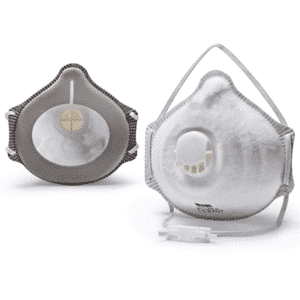
The Sir Safety FFP2 range includes valved and unvalved options with optional activated carbon for nuisance odour. Bulk Australian stock typically ships within 2 business days.
FFP3 is required, not optional, for the following exposures under Australian WHS:
The Sir Safety FFP3 range includes all the standard form factors plus high-efficiency foldable models with integrated activated carbon for combined particulate and odour protection.
This is the part most procurement teams miss: a respirator’s filter class is meaningless without an effective face seal. AS/NZS 1715 requires quantitative or qualitative fit testing for every wearer, every respirator model, before issue.
A perfectly-fitted FFP2 outperforms a poorly-fitted FFP3 by a large margin. ProfTek supplies fit-test kits and can connect you with certified AS/NZS 1715 fit-test providers across Australia.
Disposable respirators are typically the highest-velocity SKU in any industrial PPE budget. A single-shift NR-marked respirator must be retired at end-of-shift or earlier if it becomes damaged, contaminated, or breathing-resistant. Sites consuming 100+ respirators per week per crew should consider:
Start by checking the contaminant’s SDS for its WEL and review the relevant Code of Practice. If the contaminant is on the cancer-causing or sensitiser list, default to FFP3. Otherwise, FFP2 is your workhorse, and where it’s compliant, it’s the right call on cost grounds alone.
ProfTek supplies the full Sir Safety EN 149 range across Australia and New Zealand. Need help specifying the right class for your application? Contact our team with your SDS or hazard register and we’ll send back a matched product list with bulk pricing.